
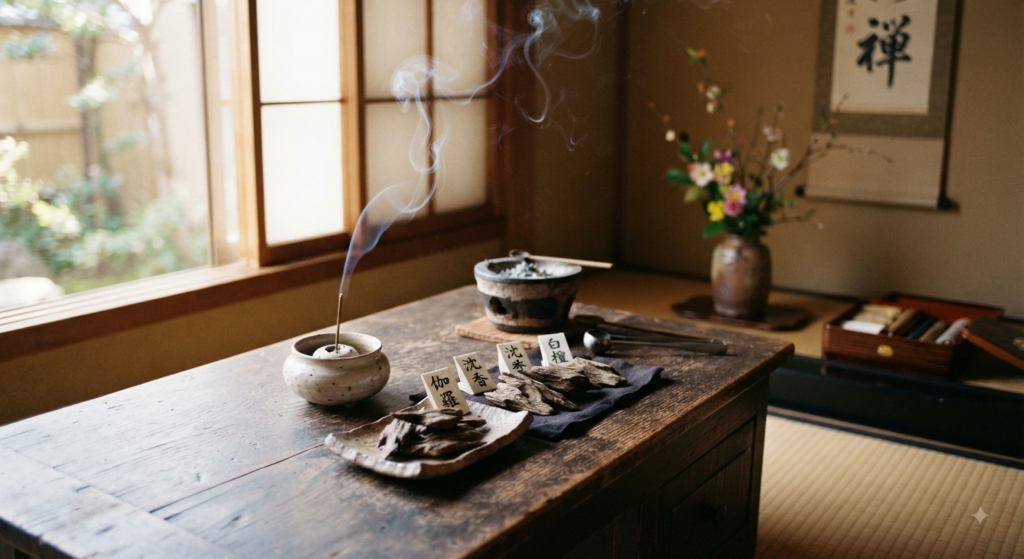
Many people use scents to relax or refresh themselves, and a wide variety of aroma products are available today.
The term “aromatherapy” has become widely known and a familiar part of daily life.
Japan has long had a tradition of enjoying scents.
Incense was introduced to Japan from China along with Buddhism in the 6th century.
Initially used in Buddhist rituals, its purpose shifted during the Heian period toward the style of “enjoying the fragrance” that exists today.
In the world of incense, the act of experiencing the scent is described as “listening” to it rather than “smelling” it.
The refined art of appreciating and distinguishing these fragrances is known as Kodo (the Way of Incense); it is considered one of Japan’s three great traditional arts, alongside Chado (the Way of Tea) and Kado (the Way of Flower Arranging).
The materials used for incense are aromatic woods known as koboku.
In Japan, three specific types—Kyara, Jinkoh (agarwood), and Byakudan (sandalwood)—are classified as koboku; all originate in Southeast Asia.
The most historically famous piece of aromatic wood is Ranjatai, which is housed in the Shosoin repository in Nara.
It became a symbol of power because many rulers—including emperors and shoguns—would bestow fragments of it as rewards upon those who had distinguished themselves.
Oda Nobunaga is particularly famous among the rulers who cut sections from Ranjatai; the specific spots where he removed pieces are marked with tags.